
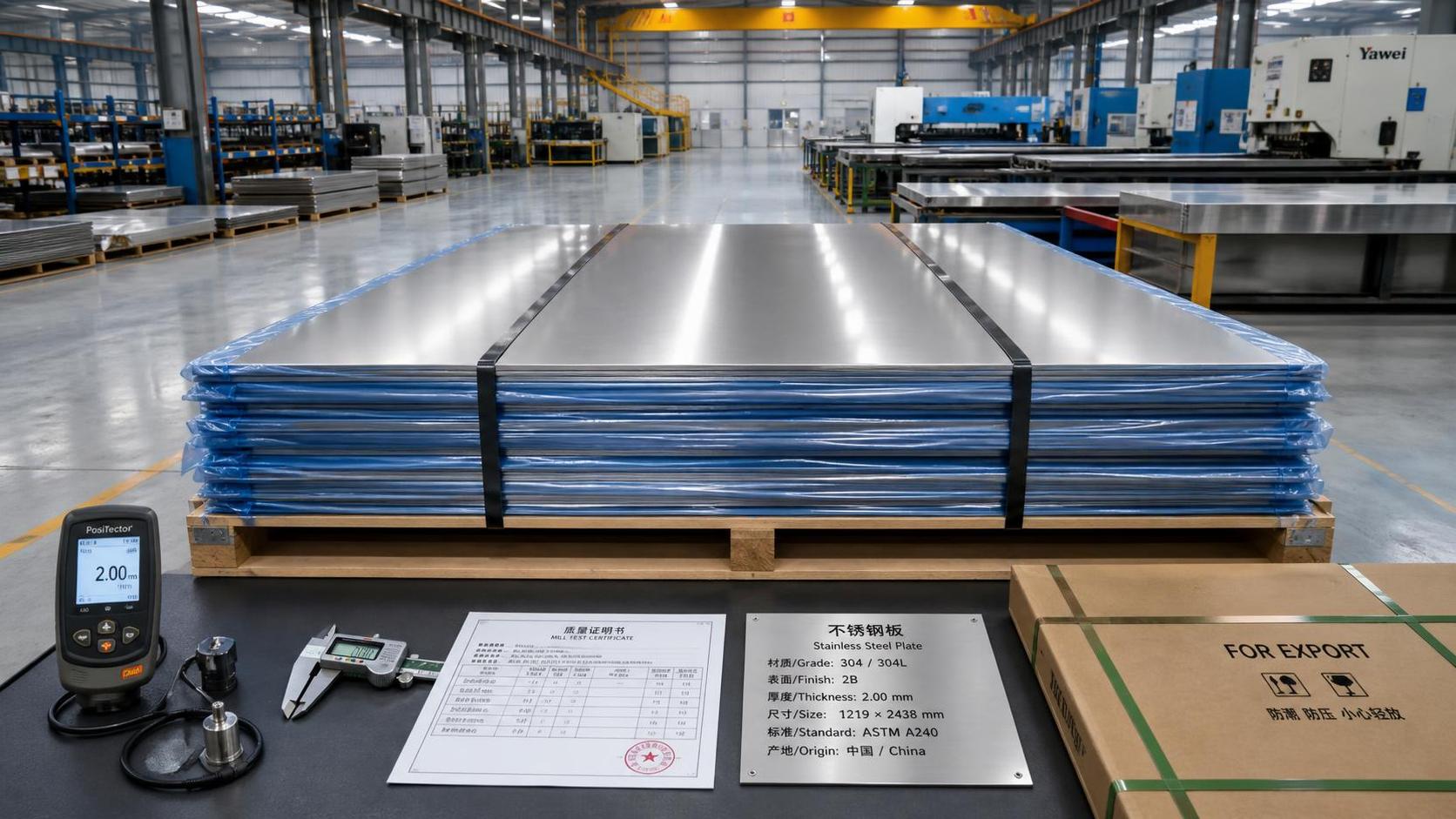
What buyers should confirm before ordering stainless steel plate
Before a stainless steel plate order is released, most buyers already have the obvious items on paper: width, length, thickness, quantity, and target price. In practice, those are only the easy parts. The real problems usually start later, when the plate reaches fabrication or installation and someone discovers the grade is technically “similar” but not suitable, the finish does not match the end use, the tolerance is outside what the laser cutting line expected, or the test documents are incomplete for the project file.
This is why experienced purchasing teams treat stainless steel plate as a specification item, not a commodity item. Two plates can look nearly identical on a quotation sheet and still carry very different downstream risk. If the order is cross-border, the need for clarity becomes even sharper: standards may differ, ports may affect lead time, and a missing detail in the purchase order can turn into a claim discussion weeks later.
For companies sourcing from global steel suppliers, including exporters based around the Shandong port cluster such as Shandong Rongxin Metal Manufacturing Co., Ltd., the safest approach is simple: confirm every item that affects use, processing, documentation, and delivery before payment terms are finalized. That takes a little more work upfront, but it is usually much cheaper than rework, rejection, or site delay.
Grade is not a formality
One of the most common purchasing mistakes is treating grade selection as interchangeable as long as the material is “stainless.” It is not. A buyer should confirm the exact grade required by the application, and also the standard under which that grade is supplied. In real procurement, confusion often happens between commercial names, ASTM designations, EN equivalents, and local project documents.
For example, if the plate will be used in a mildly corrosive indoor environment, one common grade may work well. If it is heading into chloride exposure, food processing, chemical contact, or marine-adjacent service, the decision may need a different chemistry and corrosion resistance level. The supplier cannot safely guess this from plate dimensions alone. Buyers should state the service environment, whether welding is involved, whether post-fabrication polishing is planned, and whether corrosion appearance matters as much as structural performance.
It is also worth asking one practical question early: is the project calling for a grade by habit, or by actual technical need? Over-specifying raises cost; under-specifying creates failure risk. Good purchasing is not always about choosing the “best” material. It is about choosing the right one for the real duty condition.
Surface finish affects more than appearance
Buyers often focus on finish only when the plate is visible in the final product, but finish influences fabrication, cleanability, film removal, and acceptance standards as well. A decorative panel, a tank skin, and a fabrication blank may all use stainless steel plate, yet they do not need the same surface condition.
The purchase order should clearly define the required finish rather than relying on a vague description such as “good surface” or “for decoration.” Terms like 2B, No.1, BA, or brushed finishes have practical meaning in supply and inspection. If protective PVC film is required, that should also be stated, including whether one side or both sides need protection. In export business, small omissions here lead to very familiar disputes: scratches accepted by the mill but rejected by the end user, film residue after transit, or a finish that is technically correct but visually inconsistent across batches.
If appearance matters, buyers should also confirm the acceptance basis. Is the plate inspected under warehouse lighting, daylight, or after fabrication? At what viewing distance? Without that agreement, “surface defect” becomes a subjective argument.
Thickness tolerance and flatness deserve separate attention
Many disputes happen even when nominal thickness is correct, because nominal thickness is not the same as actual delivered thickness at every point of the plate. For laser cutting, bending, pressure applications, or machined components, tolerance can matter almost as much as grade.
A buyer should confirm the applicable thickness tolerance standard, not just the nominal thickness itself. If the project is sensitive to weight, weld fit-up, or forming consistency, ask for the expected tolerance range in writing. The same goes for width and length tolerance where nesting yield matters.
Flatness is another point that gets ignored until the plate reaches the workshop. Plates intended for fabrication tables, cladding work, or visible assemblies may need tighter flatness control than standard stock. If a plate is to be cut into smaller parts, slight wave or crown may be manageable. If it is to be installed as a large exposed panel, that same condition may become a rejection issue. This is one of those details buyers should raise before the quotation is approved, not after production.
Confirm the standard, not just the product name
“Stainless steel plate” is a product description. It is not a full specification. The order should state the relevant standard for material, dimensions, testing, and in some cases heat treatment or surface delivery condition. In international trade, this becomes especially important because mills, traders, and end users may each refer to different standard systems.
When the purchase file is incomplete, suppliers may quote based on a common market standard while the buyer assumes a project standard. That gap is where costly misunderstandings begin. If your engineering or quality team references ASTM, EN, JIS, or another framework, align that before the proforma invoice stage. It is far easier to compare offers when every supplier is pricing the same requirement.
Mill test certificate, traceability, and document package
For many purchasing departments, documentation becomes urgent only when customs clearance, project QA, or third-party inspection starts asking for it. At that point, it may be too late to recover missing records cleanly.
Before ordering, confirm what document package is required. In many transactions this at least means a mill test certificate showing heat number and relevant chemical and mechanical results under the applicable standard. If your project requires origin documents, packing lists with traceability marks, third-party inspection, or additional test reports, those requirements should appear on the order and be acknowledged by the supplier.
Traceability is not just a paperwork preference. If plates are cut, repacked, or mixed from multiple heats, the buyer should know how identification will be maintained. This matters in sectors where later material verification is part of project closeout or warranty management.
Processing method changes what you should ask for
A stainless steel plate intended for stockholding is one thing. A plate heading straight into laser cutting, waterjet, bending, welding, machining, or polishing is another. Buyers who share the downstream process usually get better quotes and fewer surprises, because the supplier can judge whether edge condition, flatness, protective film, or plate origin should be controlled more tightly.
For instance, if the plate will be heavily welded, it is sensible to clarify whether any specific welding performance considerations apply in your project documents. If the material will be mirror polished later, existing surface consistency becomes much more important. If it will be used for food-contact equipment, finish and cleanability may matter more than cosmetic perfection on the reverse side. Processing intent helps the supplier recommend what is necessary and what is not worth paying extra for.
Sheet, plate, cut-to-size, and stock origin are not the same commercial item
Another practical point: buyers should be clear whether they are purchasing mill plate, cut-to-size material, or service-center processed stock. In everyday trade, those may all be quoted under similar product names. But origin, edge condition, dimensional consistency, available documentation, and lead time can differ.
That does not automatically make one option better than another. It depends on the project. If the requirement is urgent and standard dimensions are acceptable, local stock or service-center processing may make sense. If the project needs strict traceability, exact chemistry route, or large volume consistency, mill-origin material may be the safer path. Purchasing teams should confirm this explicitly instead of assuming all sources are equivalent.
Packing and logistics can damage good material
Stainless steel plate can leave the supplier in perfect condition and still arrive with edge damage, moisture staining, film issues, or handling marks. For export orders, especially container shipments, packing details matter more than many first-time buyers expect.
Confirm whether the plates will be packed on wooden pallets or steel skids, whether interleaving is used, how bundles are secured, and whether export packing needs any special compliance for the destination. Also discuss lifting method if the material is heavy. Plates that are difficult to unload safely often suffer damage at the last stage, and then responsibility becomes hard to sort out.
Suppliers operating through major export hubs, such as companies shipping through the Shandong port cluster, often have established packing routines for plates, coils, tubes, and structural profiles. Even so, the buyer should not leave packing to assumption. The right packing standard depends on plate finish, transport mode, storage duration, and destination climate.
Lead time, Incoterms, and claim window should be written clearly
Price comparisons are often misleading when delivery terms are not aligned. A quote under FOB, CFR, CIF, or another term is not directly comparable unless the buyer understands what is included and where risk transfers. This is routine trade knowledge, but it still causes avoidable confusion in steel procurement.
Lead time also needs to be separated into production time, port handling time, and transit time. If the material is being bought for a shutdown, installation slot, or subcontract fabrication window, those details should be checked carefully. “Fast delivery” is not a useful commitment unless it is tied to a date, quantity, and shipping basis.
One more item buyers should insist on: the inspection and claim procedure. How many days after arrival can visible damage or dimensional issues be reported? What evidence is needed? Is third-party inspection required before shipment or after arrival? A clear claim process protects both sides.
A practical pre-order checklist
If the order is important enough to affect production or project schedule, confirm these points before releasing it:
- Exact grade and applicable standard
- Dimensions plus tolerance requirements
- Surface finish, film, and visual acceptance basis
- Flatness or edge condition if relevant to fabrication
- Mill certificate and any extra document requirements
- Traceability method and marking
- Processing purpose: cutting, welding, polishing, forming, machining
- Packing method and export handling needs
- Incoterm, shipping point, and lead time breakdown
- Inspection method and claim window
None of this is complicated on its own. The issue is that buyers often confirm only half of it, then assume the other half is “standard.” In stainless steel plate purchasing, assumptions are expensive.
The strongest purchase orders are usually the clearest ones. A supplier that exports stainless steel and carbon steel plates, coils, tubes, galvanized products, and structural profiles will generally be able to respond much more accurately when the intended application is explained well. That is especially true in global supply chain transactions, where distance makes informal correction harder.
If there is one habit worth keeping, it is this: do not approve a stainless steel plate order until engineering, purchasing, and quality would all read the same line item and understand the same material. That single check prevents a surprising number of problems.
Please give us a message
We welcome your interest in our products and welcome your request for customization. We look forward to establishing successful business relationships with new clients around the world and providing high-quality services for projects in diverse fields.


